

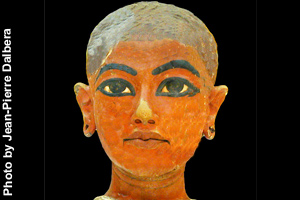
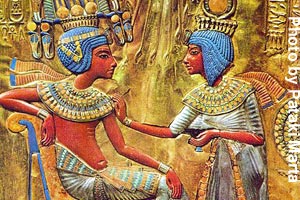

King Tutankhamen ruled Egypt over 3,300 years ago. These days, people call him King Tut. Tut became king at the age of eight or nine. He also got married. His wife was a very close relative. His wife had two daughters, but both died before they were born.
Tutankhamen died when he was about 19. No one is quite sure how he died. Scientists used to think he was bashed in the head. Now they think his head may have been broken after he was dead. His mummy has a broken ribcage, as well. He may have had an accident. In 2010, scientists found traces of malaria in his mummy.
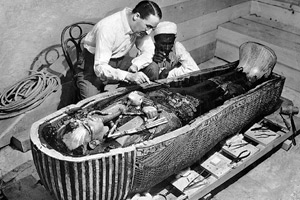
Because he died so soon, Tut was buried in a small, borrowed tomb. Usually, kings’ tombs were raided. Their treasures were stolen. But Tut’s tomb was soon forgotten, so very little was taken. It was discovered by Howard Carter in 1922.
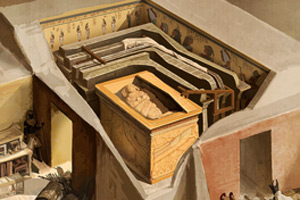
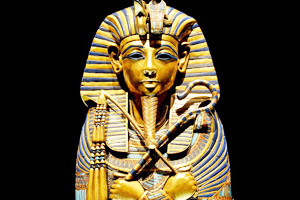
The sarcophagus, or stone container, in the burial room contained three coffins, one inside the other. King Tut’s mummy was in the innermost coffin. Over his face was a solid gold mask. It was made to look like King Tut.
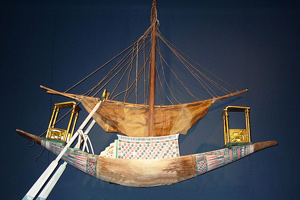
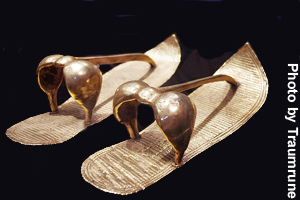
Hundreds of objects were found in the tomb for his afterlife. Many of the objects were decorated and covered in gold. There were chariots and boat models. Several board games were in the tomb. Tut must have intended to spend a lot of time in his afterlife playing.
Scientists have learned a lot about ancient Egypt by studying King Tut and his tomb.
Ask Smithsonian: How did King Tut die? [Video file]. (n.d.). Retrieved from http://www.smithsonianmag.com/videos/category/ask-smithsonian/ask-smithsonian-how-did-king-tut-die/?no-ist
British Museum - Tutankhamun, King of Egypt (1336-1327 BC). (n.d.). Retrieved from http://www.britishmuseum.org/explore/highlights/article_index/t/tutankhamun,_king_of_egypt_13.aspx
Bunson, M. (2002). The encyclopedia of ancient Egypt. New York, NY: Facts on File Publications.
Dorman, P. F. (2013). Tutankhamen. In Encyclopedia Britannica. Retrieved from http://www.britannica.com/EBchecked/topic/610635/Tutankhamen
King Tut. (2015). Retrieved from http://www.biography.com/people/king-tut-9512446
Tutankhamun (1336 BC - 1327 BC). (n.d.). Retrieved from http://www.bbc.co.uk/history/historic_figures/tutankhamun.shtml
Williams, A. R. (2013, November 6). Mystery of King Tut's death solved? Maybe not. Retrieved from http://news.nationalgeographic.com/news/2013/11/131106-king-tut-mummy-death-mystery-solved-archaeology-science/
APA Style: King Tutankhamen. (2015, July). Retrieved from Facts4Me at https://www.facts4me.com
MLA Style: "King Tutankhamen." Facts4Me.com. Jul. 2015.
APA Style: Deborah Sampson. (2014, August). Retrieved from Facts4Me at https://www.facts4me.com
MLA Style: "Deborah Sampson." Facts4Me.com. Aug. 2014. https://www.facts4me.com