


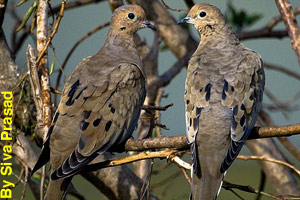

The mourning dove got its name because it sounds so sad. It says oo-AH oo... oo... oo.... Many people think they are hearing an owl.
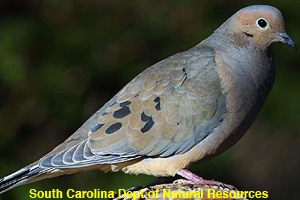
This is a thin dove with a small head. It is around 12 inches (30 centimeters) long. On top, it is brownish-gray. Underneath, it is lighter and pinker. It has black spots on its wings. Its tail is long. It moves its head back with each step when it walks.
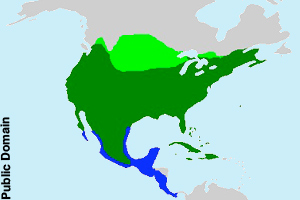
The mourning dove lives in most of North America south of the Arctic. If it lives in the north, it will fly south for winter. It is the most popular game bird in the United States. Millions are shot each year. Others die of lead poisoning from eating spent bird shot.
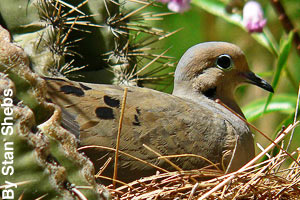
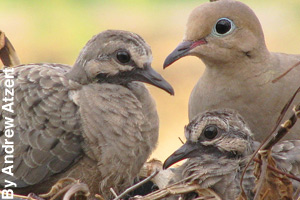
There are lots of doves left, though. This dove can have up to six broods a year. Male and female stay together all season. They sit close and preen each other. After choosing a site, the female builds a flimsy nest. The male helps by bringing twigs, grass and pine needles. The female lays two white eggs. They hatch in about 14 days. The parents feed the babies crop milk. That is a fatty slush made in a dove’s crop.
The mourning dove does not usually live long. The average life span is about 1.5 years. That is because it is hunted. One captive dove lived over 31 years. The oldest known wild mourning dove was nine years old.
Cornell Lab of Ornithology. (2012). Mourning Dove. Retrieved from http://www.allaboutbirds.org/guide/Mourning_Dove/id
Emiley, A. and T. Dewey. (2011). Zenaida macroura. Retrieved from http://animaldiversity.ummz.umich.edu/site/accounts/information/Zenaida_macroura.html
All-Birds.com. (2012). Mourning Dove. Retrieved from http://www.all-birds.com/Mourning-Dove.htm
South Carolina Department of Natural Resources. (2012). Mourning Dove. Retrieved from http://www.dnr.sc.gov/marine/mrri/acechar/specgal/mourndov.htm
Storer, Pat. (2011). Animal Terms. Retrieved from http://www.treasureranch.com/treasure/rzuinfofiles/terms.html
APA Style: Mourning Dove. (2013, June). Retrieved from Facts4Me at https://www.facts4me.com
MLA Style: "Mourning Dove." Facts4Me. Jun. 2013. https://www.facts4me.com.