


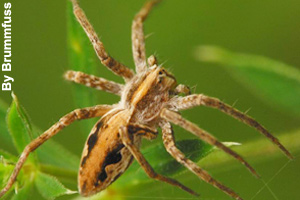
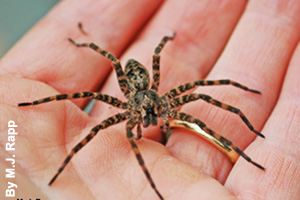

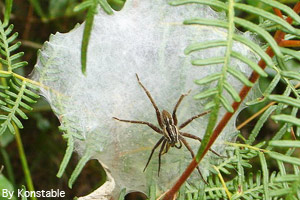
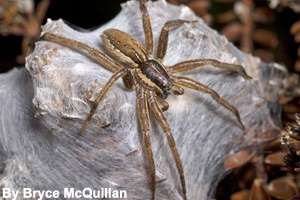
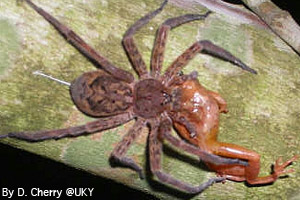

The fishing spider is a large spider. It has a stripe down each side of its body. A fishing spider lives near lakes and streams. It hides under rocks. It hides around boat docks and rafts. You will not find this spider living in your house.
Unlike most spiders, a fishing spider can see very well. It does not need a web to find its food. It hunts during the day. It runs after its prey by skating on top of the water. If needed, it can dive under water. It has tiny claws at the end of its front legs. The claws help them grab the prey. The fishing spider likes to eat insects, tadpoles, and small fish.
Another name for the fishing spider is the nursery web spider.
The female spider lays her eggs in June. She puts her eggs in a sac. She will carry the sac around until the eggs hatch.
The eggs hatch between July and September. The mother spider builds a special nursery web for the baby spiders. She guards her young spiders for three to six days. Then the young spiders hunt by themselves.
Some people keep fishing spiders as pets.
Fishing spiders. (n.d.). Retrieved from https://eol.org/pages/89077
Fishing spider. (n.d.). Retrieved from https://extension.psu.edu/fishing-spider
Fishing spider: Habitat and care. (n.d.). Retrieved from https://blogs.thatpetplace.com/thatreptileblog/2014/07/08/fishing-spider-habitat-and-care/#.X1-9k9Z7kUx
Lind, N. (n.d.). Fishing spider facts. Retrieved from https://cutehomepets.com/fishing-spider-facts/
APA Style: Fishing Spider. (2020, September). Retrieved from Facts4Me at https://www.facts4me.com
MLA Style: "Fishing Spider." Facts4Me. Sep. 2020. https://www.facts4me.com.